

GEOLOGY
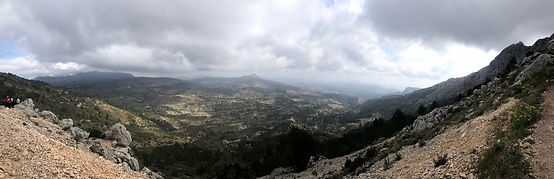
It is oriented approximately from the west to the east, according to a south-east northwest direction and a length of about 9 kilometers. Constituted by limestone creatuñas in its middle and eocene part in the upper section, the tectonic action has clarified a violent relief, perfectly defined in the its morphology of slopes of strong inclination and rocky cusp. A crest crosses the mountain range in almost all its length, with a height sustained medium of 900 m., which has its highest elevation in the Bèrnia, of 1,129 m. above sea level .Two transverse faults limit the saw in its length : to the west , through the valley of Tàrbena and high course of the Algar , and , to the east , by the Barranc del Salat .
A saline diapiro is a structure formed by the slow intrusive ascent of a plastic mass of evaporites (halite and plaster) and clays that deform and cross overlapping rocky layers.
It is a multi-faceted and complex diaphane whose activity had to start during the Cretaceous although its maximum ascension activity was It produced about 18 million years ago, coinciding with the beginning of the Prebético folding of Alicante.
The diaper of Alteageneró has a large dome, probably more than two thousand meters high, developed on what today is the depression of Altea-Callosa. This dome would originate an island in the lower Miocene sea that then occupied the region.
The Betic Mountains or the Bética Systems are the set of mountain ranges that constitute the most western segment of the system of Indo-European alpine folding. They extend from the south of the Iberian Peninsula - from the Gulf of Cádiz - to Alicante and the Balearic Islands. They are part of the Arc de Gibraltar.
The high erosionability of the Keuper materials made the dome be denuded with
Relative rapidity and only the most resistant cretácicas y paleógenas rocks remaining as remnants
from the margins of the original slide structure, such as the Bernia and Ponoig mountain ranges.
The relief of these areas is mainly conditioned by the dissolution of rocks; It is what is called «karstification». Reactions The chemicals responsible for the dissolution of carbonates are the following:
• Dissolution of carbon dioxide:
CO2 + H2O ↔ H2CO3
• :Aqueous dissociation of carbonic acid:
H2CO3 + H2O → H3O+ + HCO3-
• :Carbonate acid attack ("calcareous")
H3O+ + CaCO3 ↔ Ca2+ + HCO3- + H2O
• Equation of balance:
CO2 + H2O + CaCO3 ↔ Ca2+ + 2 HCO3-
The dissolution and therefore the formation of the Karst relief, is favored by:
• The abundance of water;
• The concentration of CO2 in the water (which increases with pressure);
• The low temperature of the water (the colder the water is, the more charged it will be of CO2);
•Living beings (which emit CO2 in the soil through breathing, which considerably increases their content);
• The nature of the rock (fractures, composition of carbonates, etc.);
• The water-rock contact time.
A cold, humid and calcareous region, therefore, is more likely to develop a Karst relief. However, this relief is found in
all over the Earth, both in warm and humid regions.
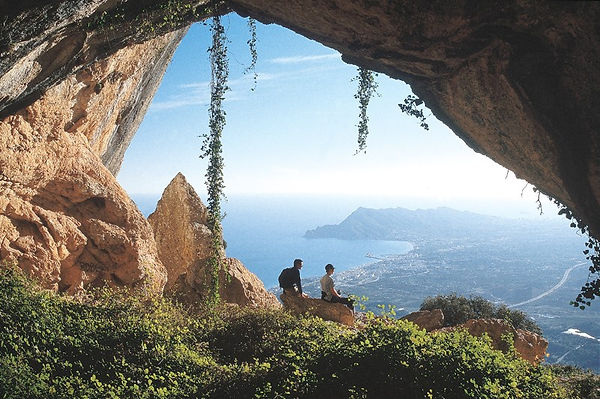
At the end of the tunnel, we get a view of: Altea, the Sierra de Gelada, Benidorm, the Puig Campana, the Ponoig or the Aitana.
The Aitana is the highest peak in the province of Alicante. It is precisely in this area where the main heights are: besides the peak that gives its name to the mountain range (Aitana, 1,558 m.)
The volcanic rocks of Cap Negret, included in this unit K1, correspond to volcanic agglomerates
Submarines, which show an important hydrothermal alteration with formation
of minerals such as pistachita, prehnita, specular, garnet, etc. The volcanic eruption responsible for the formation of
These rocks would be related to the Pangea fracturing that gave rise to the current continents and it was precisely begun for this region some 220 Ma.


The conditions of mechanical instability on the cusp of that island They made large rocky masses (olistolites) slide, especially to the north, and they would be deposited at the bottom of the sea over the Miocene margins. This sowing of large masses of older rocks on more modern materials explains the presence of Eocene limestones on Miocene leaps, which in appearance violates a basic stratigraphic principle such as that of the overlapping strata.